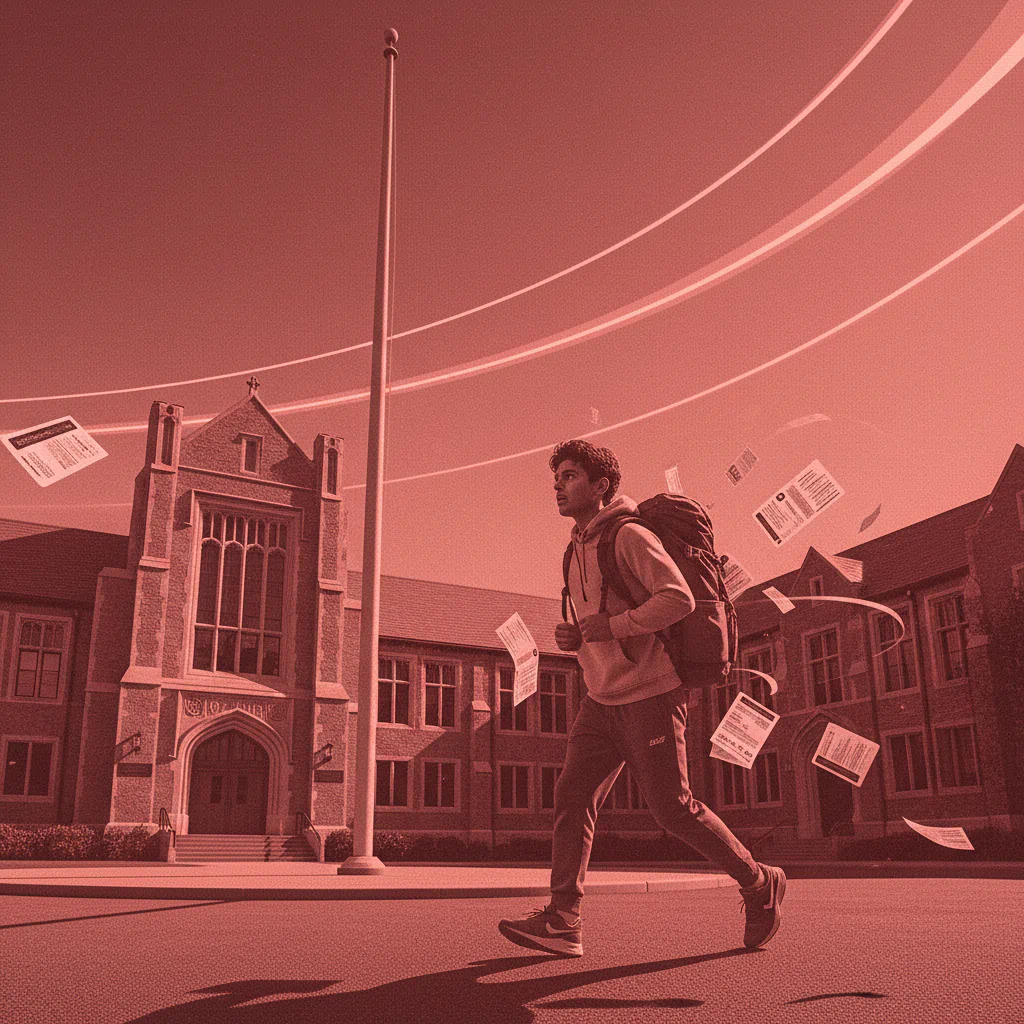
97,000. That's how many international students who should have arrived on U.S. campuses this year didn't make it. According to a Chronicle of Higher Education analysis of U.S. Department of State data, the number of new foreign students dropped by more than a third in the current academic year — the largest annual decrease outside of the pandemic.
Every enrollment office in the country is aware of this crisis. Most athletic departments are not.
That's a problem — because some percentage of those 97,000 missing students were your recruits.
What Happened to the Pipeline
The collapse wasn't gradual. It was triggered by a specific policy decision: early in the summer of 2025, the State Department froze student visa interviews for approximately one month to implement an extensive new social media vetting policy for applicants. This pause hit during the peak of visa season — exactly when the pipeline needed to be moving fastest.
The downstream math was brutal. American consulates in India, the top sender of international students to the United States, awarded just 706 F-1 visas in September 2025. India visa issuances had fallen 62% over the summer. Other high-volume countries — Nepal, Nigeria — showed similar collapses, with no September rebound to speak of.
Many institutions hoped consulates would extend processing into the fall to clear the backlog. It didn't happen. The 7,536 F-1 student visas issued across all countries in September 2025, down 18% from the previous year, barely registered against a 97,000-student deficit.
The visa crisis that crashed international enrollment wasn't a storm. It was a policy decision made in Washington — and it hit your recruits without warning.
Why Athletic Departments Are Exposed
Here's what most athletic administrators don't fully appreciate: their international recruits are processed through the same system — and the same bottleneck — as every other international student on campus.
Your tennis recruit from Chennai, your soccer forward from Lagos, your track athlete from Kathmandu — they all get their F-1 visa through the same U.S. consulate channels that just collapsed. And when those channels back up, nobody is giving your athletes priority treatment.
The International Student & Scholar Services (ISSS) office at most universities handles hundreds or thousands of international students each year. Your 30-40 student-athletes are a small fraction of that workload. When the system is under strain, triage happens — and athletic deadlines (preseason reporting dates, eligibility windows, roster locks) are not the ISS office's primary concern.
They're yours. And right now, you have no visibility into where your recruits are in the process.
The Timing Problem Athletic Departments Can't Afford to Ignore
The F-1 visa pipeline runs on a specific seasonal rhythm that is almost perfectly misaligned with athletic department needs.
Most international student-athletes receive their admission and I-20 documents in spring. Their visa interview window is June through August. Preseason reporting dates — for football, soccer, cross country, volleyball — are July and August. The overlap between peak visa processing chaos and peak athletic arrival requirements is complete.
In a normal year, this creates friction. Recruits arrive a few days late. Coaches manage around it. In a year like 2025-26, it creates crises. Scholarship athletes who can't get a consular appointment in time miss preseason. Eligibility windows close. Roster spots sit empty. The competitive disadvantage is real and measurable.
And unlike most compliance problems, it's entirely preventable — if you know about it early enough to act.
The Invisible Bottleneck Inside Your Own Campus
Even when the federal system is functioning normally, there's a structural bottleneck that most athletic departments haven't mapped: the journey between an I-20 being issued and a student-athlete physically arriving on campus involves multiple steps with zero institutional coordination.
After the I-20 is issued by the ISS office, the student is largely on their own. They must pay the SEVIS fee, complete the lengthy DS-160 application through the State Department's CEAC portal, schedule a consular appointment through a separate booking system, gather supporting documents, attend the interview, receive the visa stamp, and then book travel. At every step, there are failure points. The DS-160 application alone times out and loses progress regularly. Consular appointment availability is opaque and varies wildly by country.
No university system tracks this process in real time. No coach or compliance officer gets an alert when a recruit's DS-160 is incomplete, or when a consular appointment is three months out, or when a visa is denied and the student needs to refile. That information exists — it just lives nowhere anyone with authority to act can see it.
Political Uncertainty Compounds the Risk
The 2025-26 visa crisis may not be a one-time event. Two policy developments signal continued turbulence:
The new social media vetting policy — implemented via the interview freeze that triggered the current crisis — is permanent. Longer processing times are now structural, not temporary.
OPT uncertainty — In November 2025, the Trump administration signaled potential elimination of Optional Practical Training, the post-graduation work program that allows international students to work in the U.S. for one to three years after completing their degree. A bipartisan bill, the Keep Innovators in America Act, was introduced in response to codify OPT. The outcome remains uncertain.
OPT eligibility is a significant factor in the decision calculus of international students — particularly those considering graduate programs. If OPT is restricted or eliminated, the perceived value of a U.S. education declines. For athletic departments recruiting globally, this matters: a recruit from Brazil or South Korea is evaluating their U.S. education partly based on what it enables after graduation. That calculus is shifting.
What Athletic Departments Can Do Now
The ISS office is not your adversary in this — they're overwhelmed. The 97,000-student deficit is their problem too. What athletic departments need is not a fight with their ISS colleagues; it's a parallel capability to track, support, and escalate the immigration process for their specific population of 30-40 student-athletes who have hard arrival deadlines.
Concretely, that means:
- Know where every recruit stands in the visa process, in real time. Not at the end of the summer when it's too late — now.
- Own the DS-160 process. Don't leave it to the student to navigate alone. Pre-populate available data. Flag incomplete applications. Track completion.
- Monitor consular appointment availability for the home countries of your recruits. Lead times of 4-6 months exist in several countries. If your tennis recruit from India doesn't have an appointment booked by April, they won't make preseason in August.
- Build direct communication with your ISS office around athlete arrival deadlines — not just enrollment deadlines. They need to know which students are athletes, when preseason starts, and what the competitive consequences are of a late arrival.
- Have a contingency protocol. If a visa is delayed, what happens to eligibility? What's the appeal process? Who gets notified and when? These answers should exist before you need them.
International students contributed $42.9 billion to the U.S. economy in the 2024-2025 academic year, according to NAFSA data cited in the Keep Innovators in America Act. The global competition for that talent — and for international athletic talent specifically — is intensifying. Canada, Australia, and the UK are all actively recruiting students and athletes who are reconsidering the United States.
Athletic departments that treat immigration compliance as a reactive, administrative function will lose recruits they can't replace. The ones that build proactive systems — that know where every recruit is in the pipeline and can intervene when something goes wrong — will have a competitive advantage that compounds over time.
The 97,000 missing students weren't lost to attrition. They were lost to a system that couldn't see them in time to help.
Don't lose recruits to a process you can't see.
VeloVisa gives athletic departments real-time visibility into the F-1 visa process for every international student-athlete — from I-20 issuance through campus arrival.
Request Demo